


 (310) 773-4010

- Written by : Feodor M.
- Technical Content Marketer
- Published June 12, 2026 . 8 min read
Table of Contents |
Hiring someone to professionally wall mount your TV goes wrong more often than you would expect. Those mistakes aren't random. They follow a pattern. Unverified stud finder readings, skipped VESA specs, and power cords run through walls in violation of NEC code. Most people end up with these installers because they picked a TV installer based on the lowest price or the fastest reply without checking anything else. Those oversights lead to sagging brackets, damaged walls, and hidden fire hazards.
A few minutes of research can also save you from hiring someone who has to search Google for solutions like "how to fix a TV mount that is pulling out of the wall," or worse, a loud mount failure at 2 a.m
Run these four quick red flag checks:
- Check recent bad reviews: Read bad reviews on Yelp and Google. Repeated complaints about no-shows, crooked mounts, and wall damage signal instant red flags.
- Test response time: Send a specific question about your installation. An installer who answers clearly and promptly respects your time. One who stalls or dodges is showing you exactly how they handle problems on the job.
- Compare pricing, including installer-owned companies: The lowest number is not always the best value. The quote that covers labor, hardware, cable management, and cleanup without asterisks is.
- Ask for warranty and insurance: Request their warranty length and Certificate of Insurance. Skilled installers provide both quickly. An evasive answer is another red flag.
How to Properly Evaluate a TV Mounting Company
Start on Google and Yelp and focus primarily on the bad reviews. Here is how to read them so you catch what star ratings miss. Do not rely solely on the reviews on the company’s website. Looking at negative feedback shows problems that high star ratings often hide.
Understanding Red Flags in TV Installer Reviews
The most useful information in a review profile is not the aggregate rating but the pattern in negative feedback. Property damage, no-shows, communication failure, and recurring structural complaints are the four categories that matter. A single complaint about property damage might be an unlucky outlier. Three complaints across different months describing the same sequence of events are red flags.
Watch for bursts of praise that bury recent complaints. A cluster of five-star reviews appearing suddenly after a string of one-star complaints often signals managed reputation rather than genuine improvement. The rule is simple: ignore reviews that could have been written about anything, and take seriously any review that describes a specific installation failure. "The mount was loose when he left and the TV fell two weeks later" is a structural complaint about competence. A single negative review saying something like 'the beach was too sandy, the water was too wet' should not be a deal-breaker.
The 4-point Quick Filter to Spot Questionable Reviews.
Once you know what you’re looking for, this scan takes under five minutes:
- Review sandwich: A cluster of positive reviews immediately surrounding a negative one, especially if the positive ones use similar language.
- Suspicious timing: Multiple five-star reviews posted within days of each other from accounts with no prior review history.
- Reviewer clusters: Two or three positive reviews that reference the same vague phrases ("great job", "highly recommend") without any installation-specific detail.
- Photo scavenging: Stock-looking installation photos that don’t match the reviewer’s described scenario or location.
A wave of perfect reviews after a string of complaints is a clear warning sign. It less-likely mean the business improved. It more-likely means someone noticed the damage and started managing it.
The Reality of Word-of-Mouth Recommendations
Satisfied customers leave reviews less often than unhappy ones. According to Freshworks’ 2024 Customer Service Benchmark Report:
| Customer Type | Sharing Behavior |
|---|---|
| Unhappy customers | ~13% tell 15+ people about a bad experience |
| Happy customers | ~72% share a positive experience with 6+ people |
Since satisfied customers rarely leave reviews, the detailed ones that exist carry more weight. A low review count doesn't mean poor quality, and a high review count doesn't rule out manipulation. Prioritize reviews that describe a specific installation scenario, including wall type, mounting height, cable routing, and VESA confirmation, over any review that reads like a five-word endorsement.
How to Find Real Reviews with Precise Search Queries
Do not rely only on the reviews shown on the company's own website. Use specific search queries across independent platforms to find the unfiltered story. For example, if you’re researching TV Installation One, try:
- TV Installation One reviews Los Angeles
- TV Installation One Yelp
- TV Installation One Google reviews
Substitute any installer’s name and run each search on at least two platforms before booking. This approach helps you avoid TV installer scams that a single-platform star rating won't reveal.
What Makes an Expert TV Wall Mount Installer Worth Hiring.
Knowing a company’s review history is step one. Testing their present judgment is step two. A dedicated TV wall mount installer treats VESA verification, safety, and cable routing as daily work. A generalist handyman encounters these problems occasionally and improvises. That difference shows up in the result. For a deeper look at why paying for a specialist matters, see our piece on 6 key reasons to choose professional TV installation.
What a TV Mounting Specialist Does Differently
A specialist verifies VESA standards before drilling, manages stud depth based on the specific wall material, and handles cable routing according to NEC code rather than convenience. These are not advanced skills; they are repetition-based skills that only develop through volume. You do not need to memorize VESA specs yourself, but knowing they exist helps you spot an installer who skips this step. Common VESA ranges by screen size:
- 32-inch: typically 75x75 to 200x100 mm
- 43-inch: typically 100x100 to 200x200 mm
- 55-inch: typically 200x200 or 300x200 mm
- 65-inch: typically 300x200, 400x200, or 400x400 mm
If your installer does not mention VESA compatibility before arriving, that is worth noting. TV Installation One confirms VESA specs, stud locations, and cable routing method before any bracket goes on the wall. With thousands of installations completed across the greater Los Angeles area, those verification steps are built into the process, not added as afterthoughts. Stud finders produce false positives from pipes, electrical conduit, and plaster lath, so a specialist always verifies with a test hole or nail probe before committing the bracket position.
What to Listen for During the First Phone Call
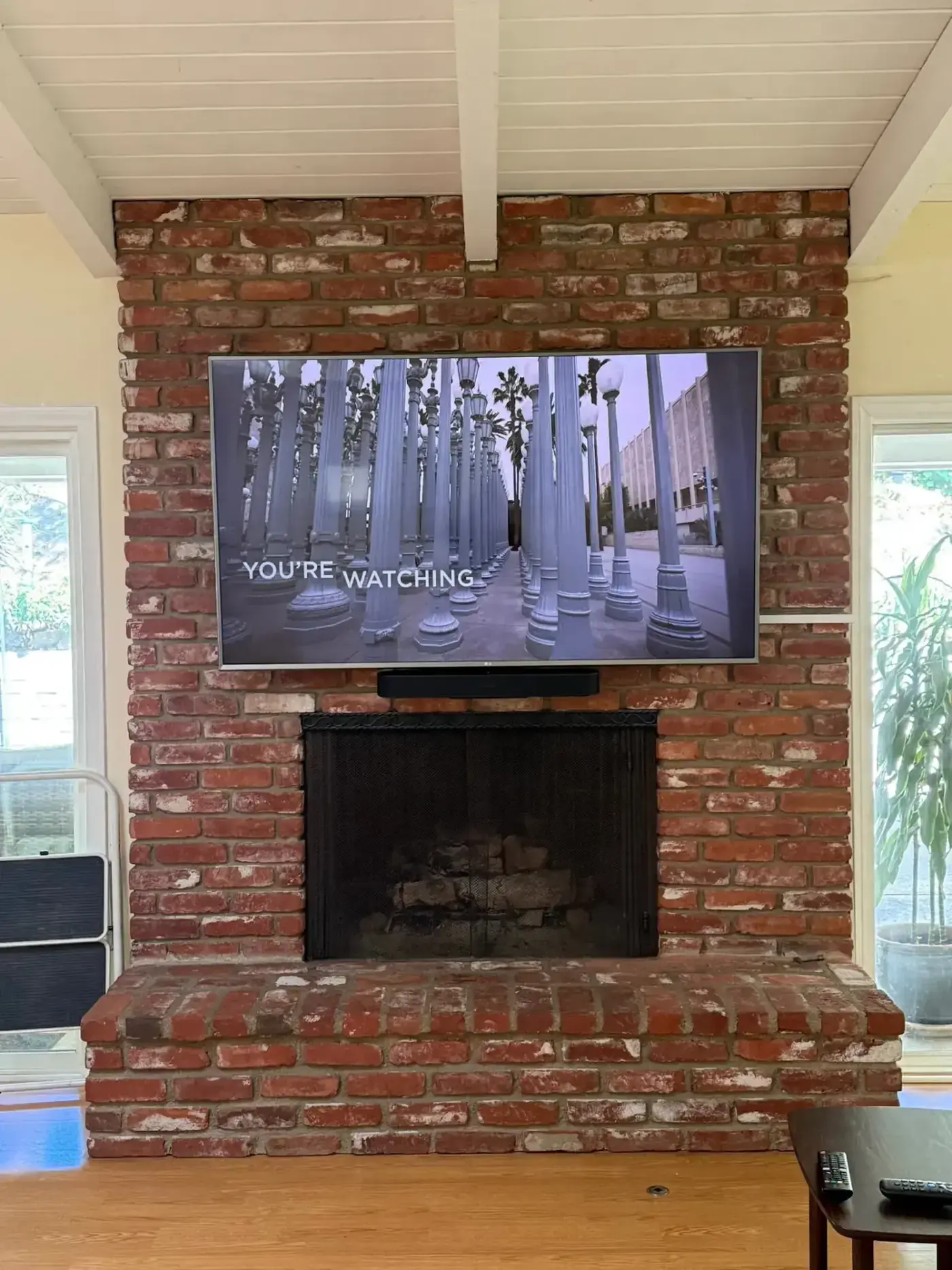
Text a wall photo to any prospective installer and ask how they would handle a Samsung Frame installation above a fireplace. A specialist gives you immediate detail about the mount type, the anchoring method for your wall, and whether in-wall cable routing is feasible in that location. A generalist says they’ll figure it out when they arrive. The difference tells you whether the technician is diagnosing the job or guessing at it.
Listen for follow-up questions. A specialist will ask about your TV model, the wall material, whether there’s a mantel, and whether you want the cables hidden. Someone who accepts the job without asking a single clarifying question is telling you what you want to hear, not what they actually need to know.
Why Daily Experience Changes the Installation Quality
Daily volume changes judgment, not just speed. A specialist who handles multiple TV mounts each day develops sharp instincts about what holds, what fails, and why that a once-a-month generalist cannot match. The practical differences show up in safety and mounting checklist:
- Load-rating judgment: Specialists know which mount hardware is appropriate for each wall type and TV weight without guessing.
- Care for screen and wall:Experienced technicians handle large panels without pressure points and protect wall finishes during bracket installation.
- Correct fasteners:The right anchor for a metal stud is not the same as the right anchor for a wood stud or masonry wall.
- Complex installation readiness:Full-motion mounts above fireplaces, pull-down brackets, and in-wall cable routing require preparation that generalists typically don't bring.
Ask any prospective installer how many TV mounts they complete each week. A specialist gives you a number. A generalist talks about "a lot of different jobs."
Crucial Questions to Ask a TV Installer Before Hiring
Three questions reveal more than a full interview. Ask them directly, and listen to whether the answers are specific or evasive.
"Can you mount this TV with no studs in the target area?"
Red flag answer: "Sure, we use anchors, no problem."
Expert answer: "We’ll locate studs first with a finder and verify manually. If studs aren’t available at your preferred spot, we’ll discuss repositioning or use a properly rated hollow-wall system designed for this load."
"How do you handle in-wall cable concealment?"
Red flag answer: "We just run the cables behind the wall."
Expert answer: "We use a listed in-wall power relocation kit or transfer the outlet within the same stud bay. Running a standard power cord inside a finished wall violates NEC code, and we don’t do that."
"What if you hit metal studs instead of wood?"
Red flag answer: "Lag bolts designed for wooden studs work fine on metal studs too, no worries."
Expert answer: "Metal studs require specific toggle anchors. For 20-gauge studs we use snap-toggle anchors rated for the load. For 25-gauge studs we’re more conservative with anchor selection and apply the appropriate safety factor to the working load calculation."
A contractor who says "yes" to every scenario without follow-up questions is signaling what they think you want to hear, not what they actually know.
Can You Trust Every Local TV Installer?
Not every TV installer can be trusted without caution. While many are skilled professionals, the industry includes unvetted contractors and uncertified handymen or maintenance team. An inexperienced installer might make errors like failing to secure the mount properly or using inadequate anchors, which could lead to a TV coming loose.
- Weekend warriors: Installers who do TV mounting between other odd jobs, without the specialized hardware or consistent practice to handle complex installs, often leave mounts that look acceptable but aren’t properly torqued.
- YouTube-trained installers:People who watched instructional videos tend to encounter scenarios their videos didn’t cover and improvise in ways that create hidden problems.
- General handymen and building maintenance teams:A building handyman or apartment maintenance crew may offer to mount your TV as a favor or a side job. They specialize in repairs, not VESA compatibility or proper mounting techniques, which can lead to issues over time.
- "Good enough" mindset:Technicians who consider a mount secure when it’s visually level miss the verification steps that prevent failures months later.
- Generic reviews:Five-star ratings left by friends or first-time customers who have no reference point for what a professional installation actually looks like can mask a weak track record.
What matters is not where someone is based but what they can demonstrate: daily volume, documented expertise, and accountability for the result. If you’re weighing whether movers should handle your mount, read our article on Should You Have Movers Install Your TV? to see the trade-offs and common pitfalls.
Cost, Warranty, and Insurance: What to Compare
A professional quote, a real warranty, and verifiable insurance are not extras. They are the basics of a serious business. Once you've confirmed who is competent, you confirm whether they are also accountable. Those are different questions, and both matter.
How Much Does Professional TV Mounting Cost?
Many customers prefer flat-rate billing because the price is fixed before work begins. There is no financial incentive for the installer to slow down or add unnecessary steps. Hourly billing creates the opposite dynamic. Based on typical market rates for professional TV mounting services:
- Basic drywall mount: $89 to $119
- In-wall cable concealment: $129 to $169
- MantelMount installation:add $80 to $120
- Brick or concrete surface:add $30 to $60
- Extra-large screens may require two technicians, priced accordingly
A complete professional quote covers placement consultation, TV and mount compatibility verification, bracket installation, component connection, testing, and cleanup. Cable routing absent from the quote entirely is where surprise fees most often appear. If the quote does not specify whether cable management is in-wall or surface-mounted, ask before choosing. The method affects both the final appearance and the cost, and discovering the difference after the installer arrives leads to billing disputes that are entirely avoidable.
Ask what’s included before anyone arrives. The cheapest bid in a group of three or four quotes deserves scrutiny, not celebration. Following these TV mounting safety tips at the quote stage prevents most billing surprises.
For broader market estimates and typical platform pricing, consult industry cost guides such as Fixr’s TV mount installation cost guide and TaskRabbit’s wall-mount TV cost guide to compare how flat-rate services and gig-platform pricing differ.
What a Real TV Installation Warranty Covers
A TV mount warranty should cover the bracket and all wall-side components for years, not days. The real difference is between a warranty that tells you what is covered, for how long, and who handles the service call versus a 30-day discretionary program with fine print that limits claims to a narrow set of circumstances. Some installer-owned companies, like TV Installation One, offer a Lifetime No-Fall Warranty on the wall bracket under normal use conditions, and that matters most when a flaw surfaces months after installation.
Why a Certificate of Insurance (COI) Matters
Without a Certificate of Insurance, the homeowner absorbs out-of-pocket repair costs regardless of who caused the damage. A TV mounting job that results in a cracked tile or a hole through a pipe is a real scenario, and the COI is the document that determines who pays. Ask any installer to share their COI before the appointment. Established companies provide it within minutes as a PDF or digital link.
A company confident in its coverage proves it instantly. A company that deflects either lacks coverage or has never been asked, and neither is acceptable. Verify that general liability coverage is active, the limits are at least $1 million per occurrence, and the policy has not expired.
Gig Platforms vs. Independent TV Mounting Companies
Excellent TV mounting technicians can be found on major service platforms. That part is true. Contractor matching sites might work well especially when a friend recommends a great installer they found on one. Personal referrals solve the trust, price, and reliability problems all at once. The thing to watch for is when a friend recommends the platform itself rather than a specific person, assuming every installer on it will deliver the same experience. One great install might not mean every installer on that platform will match.
Verified Expertise vs. Self-Attested Gig Worker Skills
Most platforms do not test TV installation skills. Listing “TV mounting” as a skill requires no certification, no test, and no skill test run by the platform. What platforms typically verify is identity and background, which confirms who a person is, not whether they know how to locate a stud in a plaster wall or select the correct anchor for a masonry surface. Five stars for assembling furniture tells you nothing about VESA pattern verification, masonry anchor selection, or stud location in a plaster-over-brick wall.
Real insurance vs. happiness guarantees
Platform satisfaction programs are discretionary programs with short claim windows. They are not traditional warranties or liability insurance. A toggle bolt installation that looks secure but isn’t fully engaged in the wall cavity is a hidden flaw that may not surface until well after a 30-day claim window closes. Ask before booking through any platform: if the mount fails on day 31, who is responsible? The answer tells you exactly how much protection you actually have.
Why Booking Platforms Deserve the Same Review Scrutiny
The same review-reading discipline that applies to individual installers applies to the platform itself. Run these searches before booking through any platform:
- [Company Name] Yelp reviews
- [Company Name] complaints
- [Company Name] Reddit
- [Company Name] Trustpilot
- [Company Name] warranty failures
What you find across those five searches tells you how the platform treats both customers and contractors. That context belongs in your hiring decision.
Local, installer-owned businesses often prioritize high-quality work because their reputation relies on community trust and they cannot absorb negative feedback, unlike large corporations. This focus on local accountability ensures a more dedicated, personalized service aimed at ensuring client satisfaction.
What Makes One TV Installer Better Than Another?
Every installer you hire is essentially local. They all work within a manageable distance to where you are as that's just how the job works.The difference is where they get their next job from, either directly or through a platform, and most importantly, how they treat each job. A local installer-owned company lives on repeat business and referrals in a specific geography. A platform technician moves to the next booking regardless of outcome. Call each finalist and ask the vetting questions from this article. The answers will make the decision.
Checklist: How to Prepare for Your TV Installation Day
Preparation before the installer arrives saves time and prevents the kind of delays that push a one-hour job to three. Clear furniture away from the wall, remove decorations and framed items from the target area, and eliminate any obstacles between the entrance and the mounting surface.
Have the TV, mounting bracket, cables, and external devices all on-site before the appointment starts. If you’re uncertain what’s needed, ask the installer for a pre-appointment checklist so nothing is missing when the technician arrives. You can also consult guides on how to find the right wall mount for your TV if you’re unclear which bracket fits your model.
Confirm your wall choice, seating distance, and mounting height before the technician arrives. The widely cited reference point for comfortable seated viewing is 42 to 48 inches from the floor to the center of the screen. Treat it as a useful starting point rather than a hard requirement, and adjust for your specific seating arrangement. If you’re planning an above-fireplace install, discuss a tilting or pull-down mount in advance so the right hardware arrives with the technician.
Be available during the installation, ask for a post-installation demo, and request maintenance guidance, especially for full-motion mounts that need periodic fastener checks. Good preparation sets the stage for a clean, professional result. The remaining question is who delivers that result consistently.
What a Dedicated TV Mounting Specialist Delivers
The experience depends entirely on who shows up. A specialized service provider who has mounted TVs on drywall, brick, plaster, concrete, and tile in single-family homes, condos, and apartments across every neighborhood in the greater Los Angeles area brings a different level of readiness than someone who handles TV mounting between other jobs. The range of wall types and living situations in LA is wide, and depth of experience across all of them matters.
How TV Installation One avoids one-star pitfalls
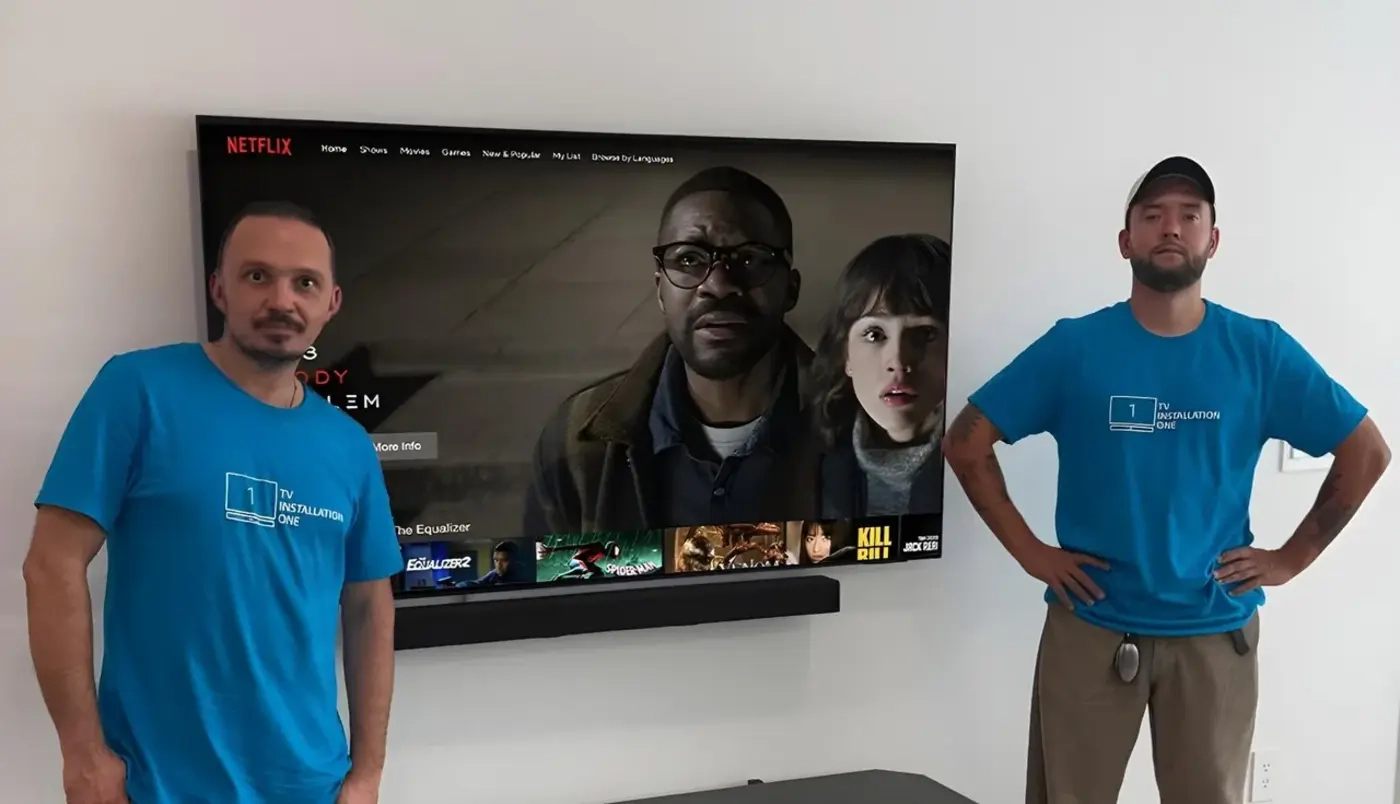
While no business is immune to the occasional piece of negative feedback, the way we run every job eliminates the most common causes. At TV Installation One, the work is backed by a Lifetime No-Fall Warranty on wall-side components. Mistakes get owned and fixed. We studied online reviews to learn from others’ mistakes before starting TV Installation One, and that process shaped how every job is approached, from the first call to the final cleanup. All reviews on Yelp and Google were earned through quality work, not incentives, discounts, or paid review services. Every mount is verified for level, load, and VESA compatibility before the bracket goes into the wall.
Here is what every job includes:
- Personally vetted team: Every technician is selected and trained directly, not dispatched from a contractor pool with unknown performance history.
- Lifetime No-Fall Warranty: The wall bracket and all installed components are covered under normal use conditions. Every bracket is verified before the technician leaves, because the goal is a mount that holds for the life of the installation.
- Accountability:If something goes wrong, we fix it. No claim windows, no fine print runaround.
- Precision over speed:VESA patterns are confirmed, studs are verified manually, and NEC-compliant cable routing is standard on every job, not optional.
- Punctual and responsive:Same-day service is available. Technicians communicate directly, not through a dispatch layer.
- Pro-grade inventory:We carry the mounts, anchors, and hardware for every wall type, including brick, concrete, and metal studs.
- Zero-mess guarantee:The job site looks cleaner when we leave than when we arrived.
- Upfront pricing:Flat-rate quotes with no surprise line items.
- Local inventory:For Los Angeles, Orange and Ventura counties: TVs and pull-down mounts available for purchase with professional installation included, saving up to 10% compared to major retailers.
Conclusion: Hire with a Checklist, Not Your Gut
TV mounting jobs go wrong before the hole is drilled because the hiring decision was made without the right information. The good news is that the right information is available, and gathering it takes about ten minutes. Check the bad reviews for patterns. Send a test question and measure the response. Compare three or four quotes, including the full scope of what each one covers. Ask for the COI and the written warranty before the appointment is confirmed. That process is what hiring a TV installer without red flags today actually looks like, and it works consistently.
For homeowners and renters looking to hire a TV installer in major cities, including the Los Angeles area, TV Installation One meets every criterion on that checklist. Verified technicians, a lifetime warranty, and thousands of installations completed across every wall type in the greater LA metro. Run the checklist on any installer you consider, including us. The answers speak for themselves.
FAQs
Can a technician route a regular TV power cord inside the wall?
No, it's a serious fire hazard and violates NEC safety standards. A professional TV installer always uses a UL-listed in-wall power relocation kit.
What exactly is a "review sandwich"?
It's when a one-star customer review is tucked between glowing reviews that use nearly identical wording, burying the criticism in a sea of praise.
How can you spot a pattern of installer incompetence?
Scan unbiased review sites over a span of months. Repeated reports, like wall damage, missed appointments, or disappearing acts, reveal a consistent red flag.